



Why use a Managed Apache Kafka service?
Apache Kafka is an open-source distributed streaming platform that powers real-time data pipelines and event-driven applications. But while Kafka’s capabilities are impressive, managing Kafka clusters from provisioning to scaling, monitoring, and ensuring high availability can quickly become a burden.
This is where managed Apache Kafka services come in. These providers offer a fully managed environment to run Apache Kafka, helping you eliminate operational overhead while supporting secure, highly available data streaming in the cloud or on-prem.
This article compares three notable Kafka providers:
- Instaclustr: a specialized platform for open source Apache Kafka
- Inteca: a Kubernetes-native Kafka partner optimized for data sovereignty and developer control
- DigitalOcean: a lightweight Kafka service focused on simplicity and entry-level deployment
Fully Managed Apache Kafka from an Open Source leader
Architecture and features
Instaclustr offers a fully managed Kafka cluster built on open source Apache Kafka, deployed on a virtual private cloud or their managed infrastructure. Their service includes Kafka Connect, Schema Registry, and stream processing tools.
High availability and uptime
They provide uptime SLAs up to 99.99%, with replicated Kafka clusters across availability zones, delivering low latency and real-time data guarantees.
Strengths
- SLA-backed uptime
- Certified open-source stack
- Cross-region replication support
- Enterprise-grade security
Weaknesses
- No Strimzi or Kubernetes-native options
- Less visibility into the underlying Kafka infrastructure
- Limited GitOps or Helm integration
Inteca: Kubernetes-native Kafka Managed Service for regulated environments
Inteca is a European Kafka provider and Advanced Red Hat Partner, delivering fully managed Apache Kafka platforms on OpenShift, Kubernetes, and hybrid infrastructure. Inteca supports both Strimzi-based deployments and the commercial Red Hat Streams for Apache Kafka, offering enterprise-grade flexibility, SLA-backed reliability, and GitOps-native control — built specifically for regulated industries like finance, public sector, and telecom.
Kubernetes + Red Hat Architecture
Inteca leverages the power of the Kubernetes ecosystem with:
- Kafka CRDs, Helm-based deployments, and full support for Kafka Connect, Kafka Topics, and KafkaUser RBAC
- Secure data transmission with TLS, OAuth2/SASL, and custom VPC configurations
- Monitoring with Prometheus, Grafana, Kafka Exporter, and Cruise Control for auto-balancing
Security, Storage & Governance
Inteca offers a complete Kafka operations layer with:
- Managed Kafka Connect for real-time integration with enterprise systems
- Tiered storage options via S3 or compatible object stores
- Offset-aware recovery, PVC snapshot support, and audit-friendly access control
Strengths
- Architected by Kafka experts, aligned with Red Hat OpenShift standards
- Designed for GDPR compliance, data sovereignty, and auditability
- GitOps-ready, DevOps-native — ideal for CI/CD pipelines and internal platforms
- Flexible deployment models: on-prem, EU cloud, private cloud, or hybrid
Considerations
- Requires familiarity with Kubernetes or OpenShift tooling (Helm, CRDs)
- Not optimized for GUI-only provisioning or lightweight prototype use
DigitalOcean: Simplified Kafka Service for developers
Lightweight Managed Apache Kafka
DigitalOcean offers hosted Apache Kafka with a developer-friendly UI and API-first deployment. Ideal for quick Kafka applications or prototypes.
Key features
- Basic support for Kafka Connect
- Preconfigured clusters with fast provisioning
- Limited monitoring and VPC options
Strengths
- Cost-effective and beginner-friendly
- Good for small workloads
Weaknesses
- No high availability architecture
- No tiered storage or RBAC
- Lacks support for streaming data pipelines in production
Kafka service comparison table
| Feature | Instaclustr | Inteca | DigitalOcean |
|---|---|---|---|
| Deployment | VMs, IaaS | Kubernetes/Strimzi | DigitalOcean Cloud |
| Kafka Connect | ✅ Managed | ✅ Helm-integrated | ⚠️ Partial |
| High Availability | ✅ 99.99% SLA | ✅ Multi-AZ K8s | ❌ None |
| Tiered Storage | ⚠️ Limited | ✅ S3/Object Storage | ❌ Not available |
| GDPR / Compliance | ⚠️ U.S.-centric | ✅ EU-hosted + RBAC | ❌ No guarantees |
| Monitoring and Logging | ⚠️ Cloudwatch only | ✅ Prometheus, Grafana | ❌ Not included |
| Fully Managed Kafka | ✅ | ✅ | ✅ |
| Pricing Transparency | Quote-based | ✅ Predictable Tiers | ✅ Simple Tiers |
What is an offset in Kafka?
In Apache Kafka, an offset is a unique ID assigned to each message within a partition. It allows Kafka consumers to track and process streaming data reliably, enabling event replay and exactly-once or at-least-once semantics.
Why should I use a managed cloud Kafka service?
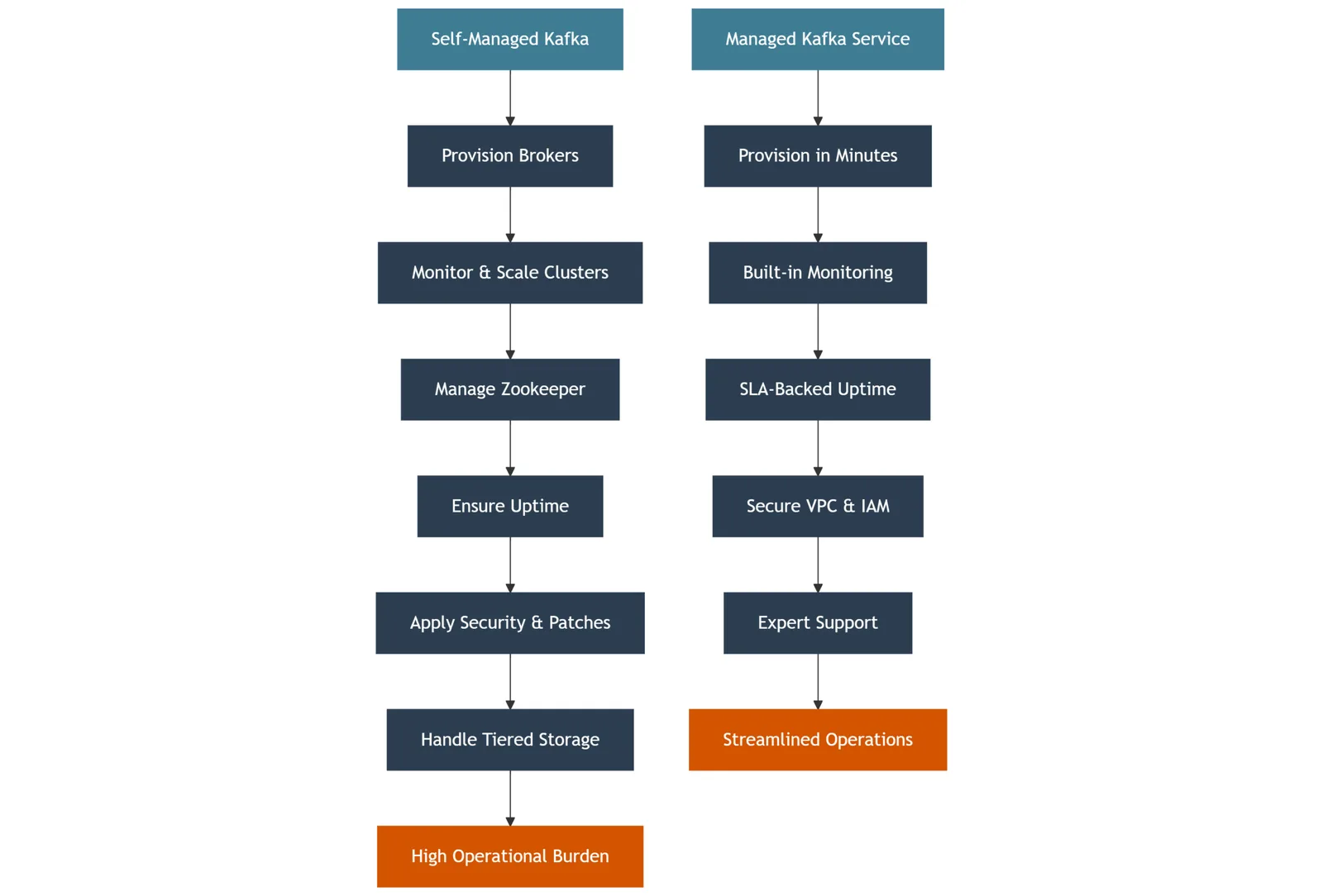
A managed service for Apache Kafka eliminates:
- The burden of patching Apache Kafka clusters
- Managing Kafka brokers and Apache Zookeeper
- Risks around uptime and cluster reliability
Instead, you get:
- High availability, tiered storage, and secure VPC environments
- Fast provisioning for Kafka infrastructure
- Expert support and cloud logging
Whether you need to migrate from self-managed Kafka, or you’re launching new real-time Kafka applications, the right fully managed Apache Kafka solution streamlines everything.
Final Verdict: Which Kafka managed service should you choose?
| Use Case | Best Kafka Provider |
|---|---|
| Fully open-source Kafka with SLA uptime | Instaclustr |
| Secure, GDPR-compliant, Kubernetes-native stack | Red Hat by Inteca |
| Simple, developer-friendly quickstart | DigitalOcean |
- Category
- Data Streaming
- Tag
- Apache Kafka