


Keycloak itself is open source, so there is no standard Keycloak license price. For enterprises, the real cost comes from running it in production: infrastructure, architecture, integrations, security, monitoring, upgrades, and support.
That means there is no single answer to “How much does Keycloak cost?” A simple internal SSO deployment can require relatively little engineering, while a multi-environment, highly available setup with LDAP or Active Directory integration, migration, Kubernetes, disaster recovery, and 24/7 support can become a significant IAM project.
Inteca prices Keycloak projects based on that architecture and delivery scope, not on the number of users or monthly active users. In this guide, we break down the main cost drivers, show what typically goes into a Keycloak project quote, and explain when customer-owned infrastructure and managed support make economic sense.
Is Keycloak free to use in production?
Keycloak is open-source software, so the community version of Keycloak is free to use and does not introduce the kind of per-user or per-MAU license fee. However, running community Keycloak in production still creates costs through infrastructure, deployment and configuration, integrations, monitoring, backups, upgrades, security maintenance, and operational support.
Enterprises can also use Red Hat build of Keycloak, Red Hat’s commercially supported distribution based on the Keycloak project. Using Red Hat build of Keycloak requires an appropriate Red Hat entitlement or subscription and provides access to Red Hat support, a defined product lifecycle, and qualified security and bug-fix patches.
A third option is managed Keycloak. Managed Keycloak is not a separate Keycloak edition: it is an operating and support model. A managed service provider can deploy and operate either community Keycloak or a supported distribution such as Red Hat build of Keycloak, depending on the customer’s requirements. The provider typically takes responsibility for areas such as deployment, monitoring, upgrades, patching, incident support, backups, availability, and ongoing operations.
For pricing purposes, it is therefore useful to distinguish three things: the Keycloak distribution you use, the cost of implementing and running the platform, and the level of managed support you require.
Keycloak pricing breakdown: what factors affect the cost?
The cost of managed Keycloak for an enterprise deployment depends mainly on:
-
Infrastructure complexity: The number of environments (dev, test, staging, production), high-availability requirements, disaster recovery, geo-distribution, and Kubernetes architecture affect deployment and ongoing operational effort.
-
Feature scope: MFA, passwordless authentication, identity federation, custom authentication flows, and advanced access policies increase configuration, testing, and maintenance effort.
-
Integrations: Connecting Keycloak to LDAP, Active Directory, SAP, CRM systems, applications, and external OIDC or SAML identity providers adds integration and testing work.
-
Migration scope: Replacing an existing IAM platform, migrating users and applications, preserving authentication flows, and planning cutover and rollback can significantly increase project complexity.
-
SLA and support requirements: Monitoring coverage, incident response times, support hours, upgrade management, and security patching determine the level of ongoing operational support required.
-
Community Keycloak vs. Red Hat build of Keycloak: Community Keycloak has no conventional software license fee, while a supported enterprise distribution such as Red Hat build of Keycloak introduces different support, lifecycle, entitlement, and procurement considerations.
Keycloak pricing models compared
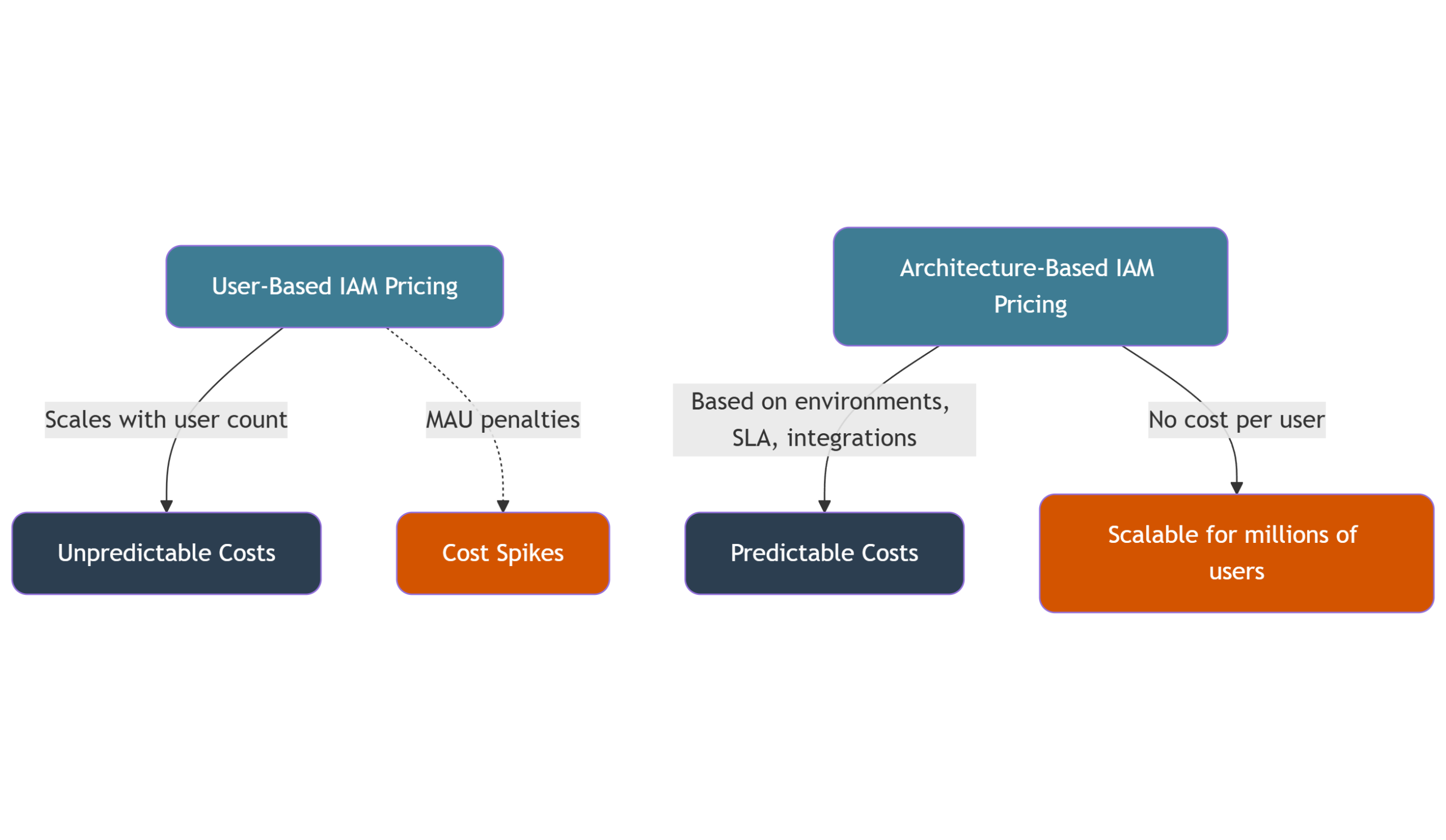
Keycloak can be delivered under different pricing models depending on who operates the platform and how the service is managed. Common models include architecture-based project pricing, fixed managed-service subscriptions, enterprise support subscriptions, and user- or usage-based pricing.
| Pricing model | How pricing works | Best fit | Main consideration |
|---|---|---|---|
| Architecture-based project pricing | Price is quoted based on architecture, environments, integrations, migration scope, implementation effort, and SLA requirements. Inteca uses this model for customer-owned Keycloak deployments. | Enterprises with complex requirements, customer-owned infrastructure, or significant integration and migration scope. | Discovery is usually required before an accurate price can be provided. |
| Fixed managed-service subscription | The provider charges a recurring fee for hosting and managing Keycloak, typically based on a predefined service package, infrastructure size, or support level rather than user count. | Organizations that want predictable recurring costs and a standardized managed service. | Standard packages may provide less flexibility for highly customized enterprise architectures. |
| Enterprise support subscription | The organization operates Keycloak but pays for a commercially supported distribution and vendor support, such as Red Hat build of Keycloak. | Enterprises that want to operate Keycloak themselves while having vendor-backed support, lifecycle management, and supported patches. | Infrastructure, implementation, and day-to-day operations remain separate costs. |
| User- or usage-based pricing | Price is tied to metrics such as users, monthly active users, authentication volume, or service tier. This model is more common among SaaS IAM platforms than community Keycloak itself. | Organizations that prefer a standardized SaaS model and relatively predictable identity usage. | Costs can increase as the user base or authentication volume grows. |
For organizations comparing managed Keycloak pricing models, providers such as Skycloak offer flat, no-MAU pricing based on a standardized managed-service model rather than architecture-based project pricing.
For more complex enterprise deployments running within the customer’s own infrastructure, pricing may instead depend on the specific architecture, integration scope, migration requirements, and operational model. This is the approach Inteca uses for its Managed Keycloak projects.
Need enterprise Keycloak?
See whether Inteca's managed model fits your architecture, integrations, compliance requirements and SLA.
Trusted by regulated enterprises





Inteca’s architecture-based Keycloak pricing model
Inteca quotes Keycloak pricing per project because enterprise Keycloak cost depends on the required architecture, integrations, infrastructure ownership, delivery scope, and support model rather than on a generic MAU tier.
The model is designed for situations where a flat published table would hide the actual project drivers. For example, two organizations can have the same number of users but very different costs if one needs simple internal SSO and the other needs multi-environment Kubernetes deployment, regulated data controls, multiple identity sources, migration planning, and production SLA.
| Quote input | What Inteca needs to understand | Why it changes price |
|---|---|---|
| Target architecture | Environments, deployment platform, network model, database model, HA, backup, and recovery requirements. | Defines engineering, DevOps, security, and operational effort. |
| Infrastructure ownership | Whether Keycloak runs in customer-owned infrastructure, customer cloud, private cloud, or another controlled architecture. | Determines access, delivery model, governance, and support boundaries. |
| Integration scope | Directories, applications, protocols, custom extensions, user migration, and downstream systems. | Integration analysis and testing can dominate implementation effort. |
| Security and compliance | Data-control requirements, audit needs, identity governance, regulated-sector constraints, and change-control rules. | Adds architecture, documentation, validation, and operational process effort. |
| SLA and support | Monitoring, response times, escalation, upgrade cadence, and post-go-live coverage. | Shapes recurring operations and support commitments. |
Why customer-owned infrastructure changes Keycloak pricing
Customer-owned infrastructure changes pricing because the delivery partner must design, deploy, secure, observe, and support Keycloak inside the customer’s architecture rather than operating a standardized vendor-only SaaS platform.
Inteca deploys Keycloak within the customer’s own infrastructure and architectural environment. Inteca is best fit for enterprises that must keep data on their own infrastructure, and brings DevOps and Kubernetes expertise to handle that architecture.
Customer-owned infrastructure affects the quote because the implementation must respect the customer’s platform rules: network zones, Kubernetes standards, database policies, observability stacks, identity sources, secrets management, backup standards, and security governance.
Best fit for Inteca’s model:
-
Enterprises that must keep identity data, logs, or operational control on their own infrastructure.
-
Organizations with data-residency, sovereignty, compliance, or architecture-governance requirements.
-
Teams that need Keycloak integrated into existing directories, applications, monitoring, and platform controls.
-
Enterprises using Kubernetes or requiring Kubernetes-ready deployment practices.
-
Buyers that need DevOps expertise for infrastructure automation, upgrades, observability, resilience, and incident readiness.
What makes up an Inteca Managed Keycloak project quote?
An Inteca Managed Keycloak project quote typically covers discovery, architecture, implementation planning, implementation, production deployment, and early-life support or SLA. The final price depends on the confirmed architecture, integration scope, infrastructure requirements, and level of ongoing support.
| Project component | What is estimated | Pricing impact |
|---|---|---|
| Analysis and architecture discovery | Current IAM landscape, business-critical applications, security goals, compliance context, migration risk, target operating model. | Reduces uncertainty and identifies the real scope before delivery. |
| Architecture blueprint | Realm strategy, environment model, federation design, HA topology, infrastructure placement, Kubernetes design, monitoring approach. | Determines complexity of platform work and future operations. |
| Implementation plan | Authentication flows, SSO approach, roles and permissions, integration sequencing, test plan, cutover approach, rollback planning. | Converts architecture into an executable delivery roadmap. |
| Implementation and configuration | Keycloak deployment, realm configuration, federation, protocol setup, integrations, extensions, hardening, automation. | Usually the largest project component because it includes build, test, and validation. |
| Production rollout | Release preparation, operational readiness, monitoring hooks, backup checks, performance checks, security verification, go-live support. | Adds production risk management and go-live assurance. |
| Early-life support and SLA | Stabilization, incident support, monitoring, patch planning, upgrade planning, runbooks, knowledge transfer, response commitments. |
Defines post-deployment service expectations and recurring cost. |
Inteca Managed Keycloak support and SLA tiers
| Tier | Support | Response Time | Use Case |
|---|---|---|---|
| Bronze | 8×5 | 8 hours | Dev environments |
| Silver | 12×5 | 4 hours | Internal business apps |
| Gold | 24/7 | 2 hours | Customer-facing or regulated systems |
| Platinum | 24/7 | 1 hour | Fintech, healthcare, mission-critical, highly restricted industries |
All tiers include a 30-day Early Life Support phase and proactive Keycloak instance monitoring.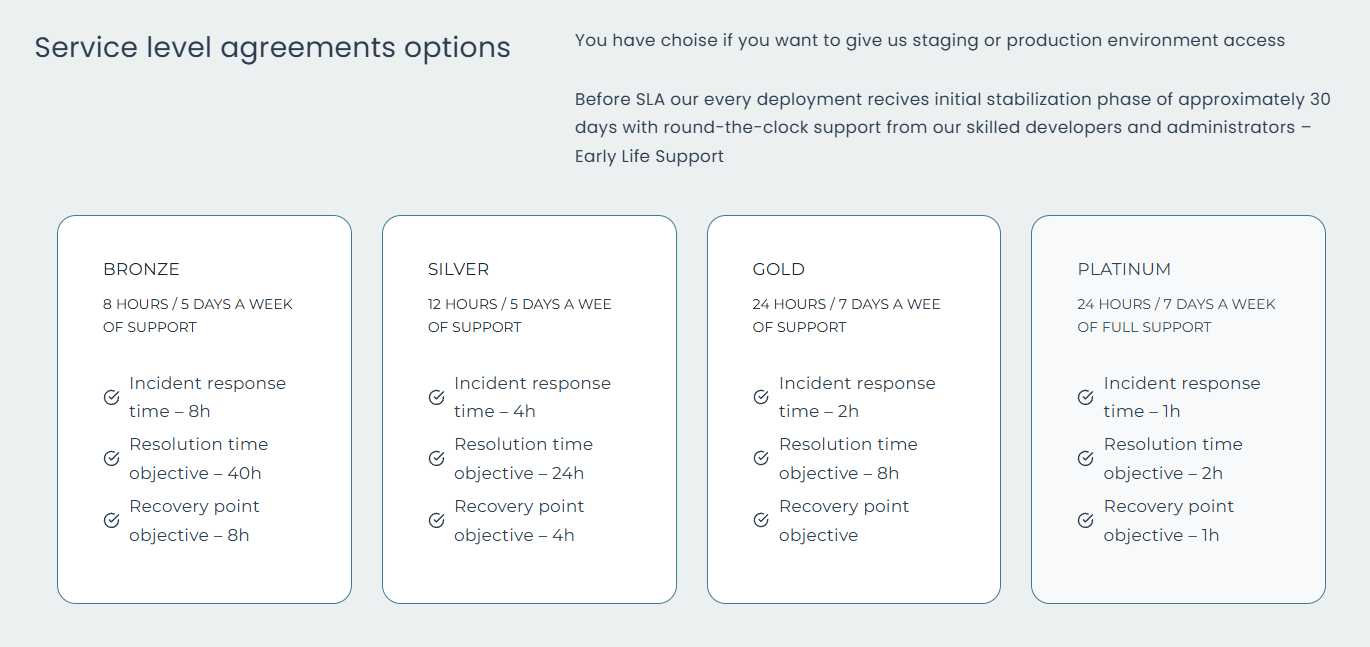
When is Inteca’s managed Keycloak model the right fit?
Inteca is a strong fit for enterprises that need Keycloak deployed on their own infrastructure, need data to remain under their architecture, and need DevOps and Kubernetes expertise to operate a secure production IAM platform.
Inteca’s model is especially relevant when generic SaaS tiers do not address data residency, infrastructure ownership, Kubernetes standards, legacy directory integrations, change governance, or production SLA expectations. It is less aligned with buyers who want only a fully standardized vendor-hosted SaaS account with published user tiers and minimal architecture customization.
Before requesting an architecture-based quote, prepare a discovery package with:
-
Target environments: development, test, staging, production, and disaster recovery.
-
Infrastructure model: customer data center, customer cloud, private cloud, Kubernetes, database, network, and access boundaries.
-
Identity sources: LDAP, Active Directory, HR system, partner identity providers, or external IdPs.
-
Application scope: apps, APIs, protocols, user groups, tenants, realms, and federation requirements.
-
Security needs: MFA, passwordless, step-up authentication, session rules, secrets, audit, and compliance controls.
-
Migration plan: existing IAM platform, user migration, cutover windows, rollback expectations, and business continuity needs.
-
Operations model: monitoring, alerting, incident response, patching, upgrades, support hours, and SLA expectations.
Need enterprise Keycloak, not just hosting?
See whether Inteca's managed model fits your architecture, integrations, compliance requirements and SLA.
FAQ